A · CHEAPER TWIN
Latest reviews2026 + reviewed paddlesEarlier paddlesBest picksReal-play durabilityRelease queueDeals & codesCommunity
FIND YOUR NEXT PADDLE
Less searching. A shortlist that fits your game.
Tell us your budget and the problem you want to solve. See up to three picks with reasons, tradeoffs and a direct comparison. Refine the feel and setup when you know what you like.
LOOK BEHIND THE RECOMMENDATION
Three ways to avoid buying the wrong upgrade.
Price alone is a weak shortcut for power in this catalog. Use shape and handling to narrow your options, then decide whether the premium buys a response you actually need. These charts explain the tradeoffs; they do not override your preferences.
CHECK THE PRICE AGAINST THE NUMBERS
Is a cheaper paddle measuring the same?
Two checks that use only the datasheet's measured swingweight, twistweight, power, pop and spin. Find the cheapest paddles that measure close to the one you are eyeing, then see whether a cheaper paddle matches or beats it on the numbers you care about. Matching numbers do not prove the same feel, surface or build quality; use these checks to pick what to demo.
B · BEATEN FOR LESS
Does a cheaper paddle match it on everything you care about?
FIRST
Buy the response you need
Low pop helps when your resets float. More easy offense can help when your put-aways sit up. A bigger price tag does not tell you which problem a paddle solves.
THEN
Match the shape and setup
Look at swingweight for the effort to move the paddle and twistweight for resistance to off-center rotation. Handle length, face outline and weight placement change the decision.
FINALLY
Check what survives play
A strong spin-retention result helps narrow the shortlist. Use actual court checkpoints to judge how the entire paddle is holding up, including its core and edge guard.
OPTIMIZE THE PADDLE YOU BUY
Put the weight where it solves a problem.
My recommended first change is 3 g total, not 4 g all at once. For side weighting, that means 1.5 g at each matching position. Select a paddle, the result you want and the material you plan to use. The guide calculates final static weight only; SW, TW and balance must be remeasured after installation.
This optimizer consolidates my personal weighting reviews: the general SW/TW and shape guide[15], the Quanta shape and magnetic-tape experiments[16], and my clip-versus-tungsten review on foam paddles.[17]
REMOVABLE TEST
PickleClips
Fast to move and reuse while you search for placement. Buy the correct thickness and check edge-guard compatibility. Current product information lists common 2 g and 3 g versions.[14]
LOW-PROFILE FINAL SETUP
Tungsten tape
Thinner and easier to hide under finishing tape. Cut by measured grams, not assumed inches. It is less convenient when you want to move the setup repeatedly.
LOW-COST EXPERIMENT
Adhesive magnetic tape
Cuttable and lead-free, but usually bulkier for the same useful mass. The paddle is not magnetic, so the strip still depends on adhesive. Check that every edge is secure before play.
Record stock static weight, SW, TW and balance.
Begin with 3 g total: 1.5 g at each matching side position.
Play the same drills: blocks, resets, counters, drives and overheads.
Remove or relocate before adding more mass.
Weigh and remeasure the final build, including finishing tape and overgrip.
Competition and safety check
USA Pickleball says properly installed aftermarket weights and weight systems can be treated like weighted tape when the approved paddle remains compliant.[12] UPA-A's published paddle rules specify flat adhesive weight along the edge, handle or butt cap and a 10 oz maximum.[13] Those rule sets are not identical. Before a sanctioned event, verify the current rules for that organizer; removable clips may not satisfy a flat-adhesive-only rule.
Keep added material off the playing face. Do not cover identifying marks required by the organizer. Stop if a clip or strip moves, the edge guard separates, or the setup creates wrist, elbow or shoulder discomfort. Check the paddle maker's warranty before attaching anything.
01 · FOAM PADDLE SHORTLIST
Start with your budget and your game.
Eleven specific models and shapes, grouped by buying need. Prices are in USD. Official list prices checked October 17, 2026; code prices are estimates from the site's codes, subject to eligibility and checkout.
Sorted by price, then name. Priority tags are editorial buying guidance. Family evidence is labeled on each card; it does not mean every shape or production batch was tested. Tax, shipping and setup accessories are extra.
02 · THE UPGRADE QUESTION
What does the extra money buy?
Choose two paddles. Compare the cost difference with the actual change in feel, setup and evidence.
PPI is my personal Paddle Performance Index. It includes feel, shape, setup and game fit; it is not a percentage of universal performance, so 89 versus 85 does not mean a paddle is 4% better. Missing personal inputs stay N/A. SW and TW use the latest datasheet sample, which may differ from the original review unit.
03 · WHERE THE MONEY MAKES SENSE
Four buying decisions that matter.
Budget foam: Tour or Spitfire?
Both list at $109.99. Our Tour review favors its dense, connected all-court response; the 10-hour Spitfire review favors a softer, lower-pop feel with elongated reach. Start with the response you prefer, then compare the evidence for the exact surface.
Spitfire's PermaGritNano was Tier 3 in the published wear test[4]. The Tour's production EverGrit result still needs a verified primary source in this guide. Neither inherits another paddle's test result.
Compare the two budget options →Pay for dense, low-pop control
The Jelly Bean 2 series lists at $169.99. Our review found a soft, dense EMA response that opened up around six hours. Its lower pop is useful when you supply your own pace and want help keeping the kitchen game calm.
Pick among Hurache-X, Vapor, Ultré and Pegasus using the measured setup. Four equal prices do not mean four identical handling experiences.
Compare reach with widebody handling →Pay for your offensive shape
The Honolulu CR options list at $195. In our series review, J6CR brings more pop and power with its elongated configuration and a sweet spot higher on the face. J2CR feels stiffer and more abrupt; J3CR offers the wider-face alternative.
J2CR LH needs 3 g total at 3 and 9 in our reviewed setup. Added weight changes handling as well as stability; remeasure after installation.
Compare CR setups →Make the premium earn its place
Coral Pro Hybrid's $220 base listing is $50.01 above Jelly Bean 2. The cited comparison[3] places both tested models in Tier 1 and describes Coral as the more offensive option. That premium buys a different response, not an automatic durability upgrade.
Demo the premium if easy offense is the missing piece in your game. If you already make pace and prefer low pop, the cheaper option may suit you better.
[3] · Compare the premium →04 · SURFACE RETENTION
Spin that stays: read the test correctly.
The cited test method[1] measures spin before and after controlled ball impacts. The published protocol describes a 60 mph baseline, a clamped 30° paddle, and 100 wear impacts at 70 mph. It measures spin retention, not a guaranteed service life or a direct percentage of physical grit remaining. [1]
| Tier | Spin loss after wear | How to use it |
|---|---|---|
| Tier 1 | Less than 5% | Strong retention under that test. |
| Tier 2 | 5% to under 10% | Compare with price and your preferred response. |
| Tier 3 | 10% to under 20% | A measurable loss; starting spin and price still matter. |
| Tier 4 | 20% or more, or a surface-class assignment | The source also places some untested traditional surfaces here. Check whether an individual model was actually tested. |
HexGrit, Blue Grit and Diamond Tough
The cited roundup[2] identifies HexGrit, Crystal Blue Endurance and Diamond Tough among Tier 1 surface families. The Ultré Jelly Bean 2 / Coral Pro comparison[3] supports those two specific models; the roundup includes J6CR Blue Grit.
Use these results to prioritize a demo, then verify the exact surface and batch on the paddle you buy.
[2]One brand, two different surfaces
Spitfire's PermaGritNano lost 14.7% spin in the published test[4]. That is Tier 3. Original PermaGrit on the P1 has different evidence. Similar names cannot substitute for a model match.
The same rule applies to ArmorGrit versus older raw-carbon Turbo surfaces, and Tour EverGrit versus V-SOL Pro. Check the version before buying.
[4]A 100-impact result is not a 100-hour guarantee. Protocols and samples change; do not combine RPM measured by a human swing with cannon-test RPM to invent a retention percentage. We will keep updating surface and spin performance through real-time play.
05 · WHAT REPEAT PLAY ADDS
The checkpoint can change the verdict.
These are recorded checkpoints from our review notes, not claims that every buyer will experience the same change at the same hour.
Break-in is not a universal bonus
Track the ball, the setup and the session conditions alongside how the paddle plays. More dwell or easier power may help one player and hurt another. A softer feel does not prove that swingweight, twistweight or static weight changed; those require another measurement.
Formula-generated guide scores are estimates. They do not establish before/after change. Personal review ratings and measured checkpoints carry that story.
06 · COST OF OWNERSHIP
How much longer would the upgrade need to last?
Use the two selected paddles above. Enter your own useful-life assumptions and setup costs. This is a buying scenario, not a durability prediction.
Annual purchase count = round up (weekly hours × 52 ÷ assumed useful life), starting with a new paddle. Setup cost is charged for each replacement in this scenario. Warranty replacements, resale, shipping, tax and transferable accessories are excluded. Break-even life for B = life of A × total cost of B ÷ total cost of A.
07 · FEEL BEFORE THE NUMBERS
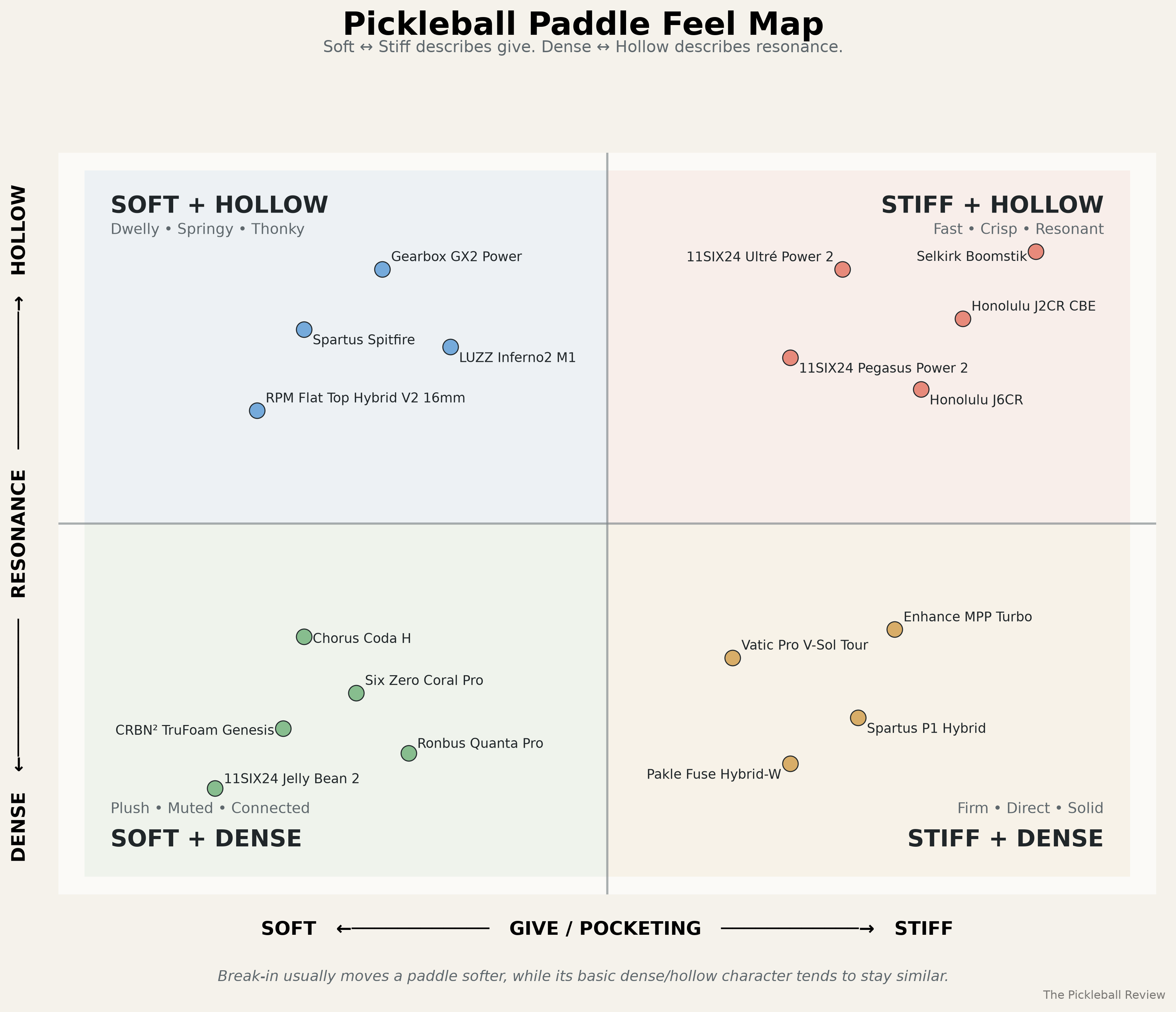
Soft or stiff? Dense or hollow?
Use the feel map as an editorial orientation tool. Coordinates are supplied review placements, not instrument readings; they do not establish a durability tier or PPI.
FOOTNOTES & PRICE CHECKS · OCTOBER 17, 2026
Sources behind the numbers.
Some shopping links are affiliate links; qualifying purchases may earn a commission. Code estimates are not checkout verification. Model availability, shipping dates and variant prices may change.