My pick is J6CR for fuller-swing offense, reach, leverage, and an unusually stable weighted setup. Choose the regular J2CR for faster kitchen positioning, easier recovery, and quick counters. Both remain stiff-hollow CR paddles after break-in; J2CR feels a little stiffer and more abrupt, but not necessarily more hollow.
The four reviewed setups at a glance
These paddles share the same foam-primary CR identity and the Tier 1 Crystal Blue Endurance surface, but they do not feel identical. The table uses the matching sample rows from the paddle sheet. Power and pop are shown as measured ball speed in miles per hour.
| Model | Shape role | Weight | SW | TW | Balance | Power speed | Pop speed | Spin | PPI |
|---|---|---|---|---|---|---|---|---|---|
| J2CR CBE | Hybrid balance | 7.89 oz | 105.11 | 6.36 | 233 mm | 56.74 mph | 37.19 mph | 2,066 RPM | 84 |
| J2CR CBE LH | Hybrid, long handle | 7.89 oz | 104.61 | 6.34 | 231 mm | 56.69 mph | 37.00 mph | 2,141 RPM | 77 |
| J3CR Blue Grit | Widebody forgiveness | 7.91 oz | 107.82 | 6.52 | 226 mm | 61.33 mph | 39.21 mph | 2,430 RPM | 87 |
| J6CR Blue Grit | Elongated attack | 7.99 oz | 112.39 | 6.34 | 234 mm | 61.20 mph | 38.89 mph | 2,371 RPM | 89 |
Review evidence: I have played the J6CR, regular J2CR, J2CR Long Handle, and J3CR. J6CR has the longest personal history because it served as one of my main paddles. The MPH, RPM, weight, SW, TW, and balance values remain tied to the matching stock samples. The weighted J6CR and J2CR Long Handle setups are discussed separately.
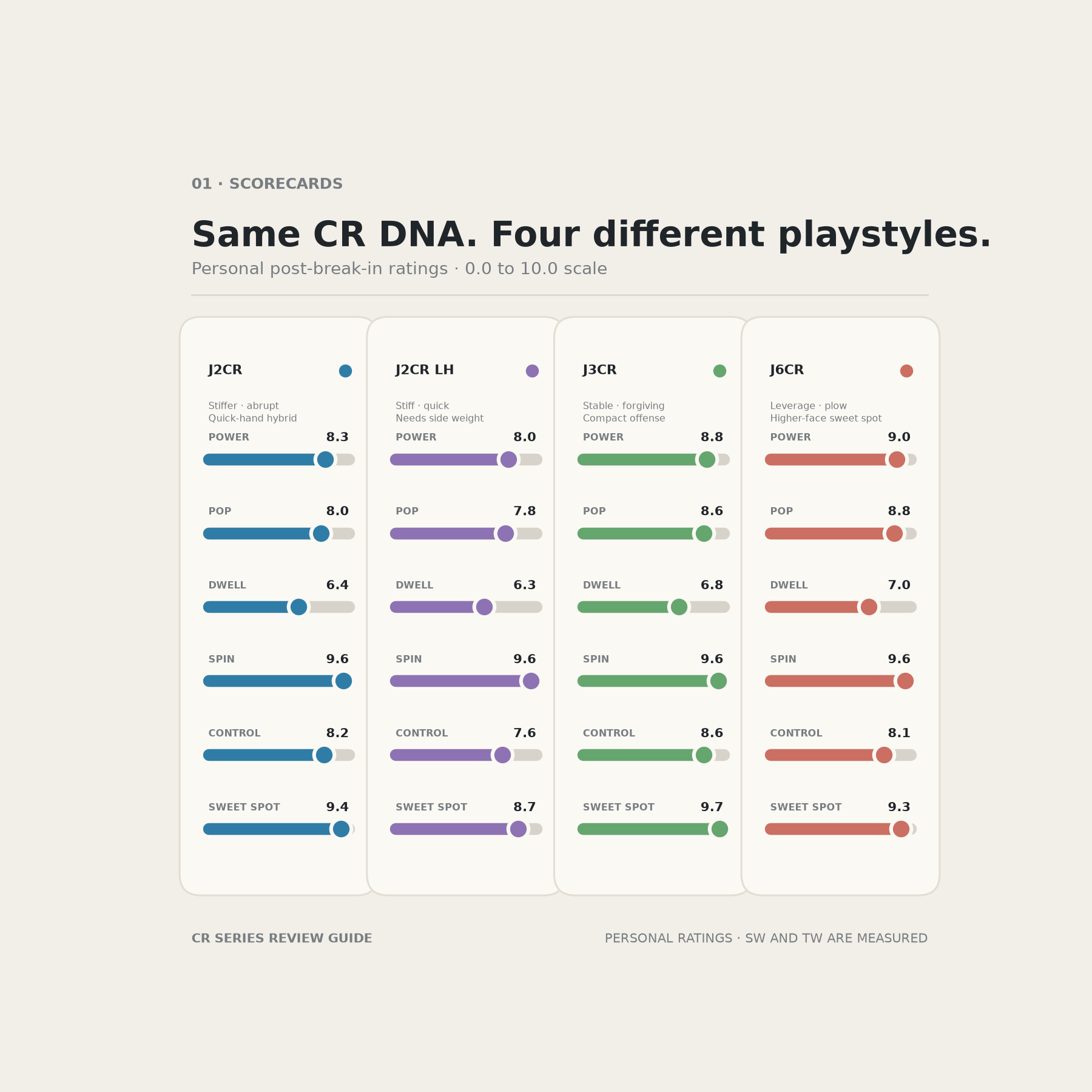
What PPI means in this comparison
PPI is my Paddle Performance Index, a 0 to 100 score for the complete paddle experience. It is not a simple average of the radar numbers, another ball-speed measurement, or a straight percentile. It uses 35 percent shape-role playing profile, 10 percent sweet spot, 10 percent feel, 15 percent stock setup and measurements, 10 percent break-in confidence, and 20 percent personal game fit. Swingweight and twistweight are included inside the stock-setup component.
The shape changes the playing role inside the score. Elongated paddles receive more attack emphasis, hybrids balance attack and touch, and widebodies place more emphasis on forgiveness. A flat-top or aero outline makes a smaller adjustment. With the newest sheet measurements and my personal fit inputs, the stock PPI scores are 89 for J6CR, 87 for J3CR, 84 for regular J2CR, and 77 for J2CR Long Handle. Radar PowerScore stays separate. A weighted PPI should be recalculated only after the new SW, TW, balance, and static weight are measured.
Blue Grit remains one of my favorite durable surfaces
Honolulu calls it Crystal Blue Endurance, but most players know it as Blue Grit. It is one of the few Tier 1 durable surfaces that still gives me something close to the aggressive feedback of fresh peel ply. The ball feels like it catches the face on rolls, dipping drives, flicks, and slices instead of sliding across a disconnected surface.
The spin is strong, but the feedback matters just as much. The J3CR Blue Grit sheet sample reached 2,430 RPM, and the J6CR sample reached 2,371 RPM. Those are elite-spin results. The larger goal is to retain useful bite beyond the early testing window. I will keep updating the spin durability result through real-time play.
They break in, but they still feel like CR paddles
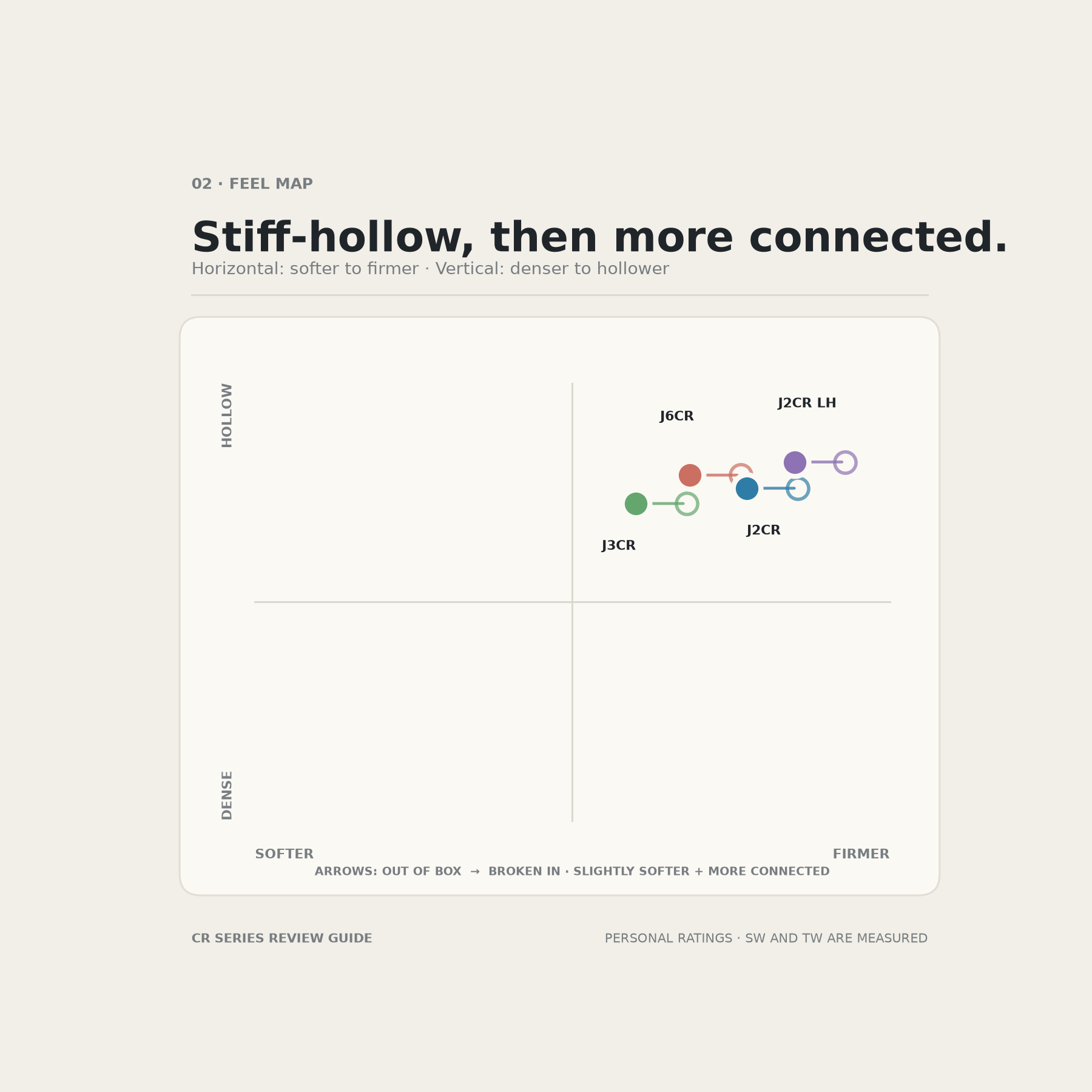
Out of the box, the CR series can feel stiff and abrupt. The ball comes off quickly, especially when I am switching from something softer and still learning how much response the face will give me.
After the first few sessions, the paddles become a little softer and noticeably more connected. There is slightly more pocketing, drops become easier to judge, counters feel less abrupt, and the overall response becomes more predictable.
I do not want to exaggerate that change. They never turn into plush paddles. The underlying personality remains stiff and hollow; break-in simply makes that response feel more connected to my hand and easier to manage.
J6CR: the one I keep coming back to
The J6CR is still my favorite CR, and a lot of that comes down to how the elongated shape interacts with this core. There is more substance behind the ball, more reach, more leverage, and a very obvious second gear when I accelerate through a drive or serve.
The matching stock sample measures 7.99 oz, 112.39 SW, 6.34 TW, and 234 mm balance. Ball-speed testing produced 61.20 mph power and 38.89 mph pop, with 2,371 RPM spin. Compared with the regular J2CR sample, that is 4.46 mph more power speed and 1.70 mph more pop speed.
The sweet spot feels like it sits a little higher on the face. That works well with my natural swing. Contact slightly above center on a drive, serve, overhead, or counter produces a strong release, so the elongated shape gives me more than additional length.
Despite the elongated profile, J6CR is surprisingly forgiving. Many elongated power paddles give me leverage but punish even a small miss outside the center. J6CR gives me a much larger usable hitting area, especially once the setup is dialed in.
J6CR gets really interesting with weight at 3 and 9
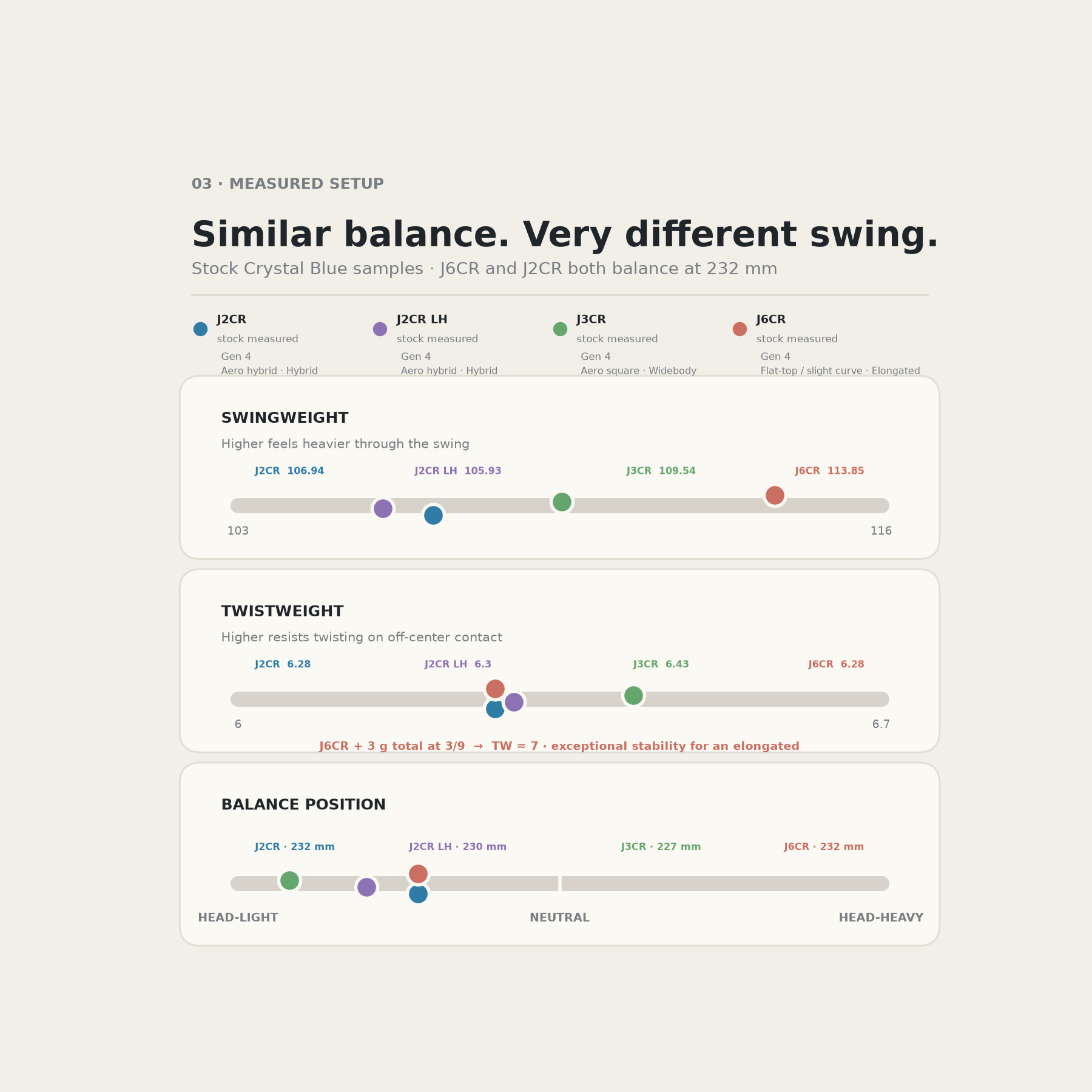
Stock, J6CR already carries enough swingweight for good plow-through without feeling excessively cumbersome. Adding around 3 g total at 3 and 9 o'clock takes the twistweight to roughly 7.
That is exceptional lateral stability for an elongated paddle. Off-center counters twist less, blocks feel more solid, and hands battles become easier because every contact does not need to be perfect. Because the mass sits on the sides instead of only at the tip, the setup gains stability without becoming massively head-heavy.
The paddle keeps its reach and leverage but starts behaving like a much more forgiving shape. For me, that ability to turn an already forgiving elongated into an extremely stable setup is one of the strongest reasons to choose J6CR.
Balance is a big part of why J6CR works
The stock balance point is 234 mm, only 1 mm above the regular J2CR. Despite the longer shape, J6CR does not feel excessively tip-heavy. The extra swingweight is present, but the balance keeps the paddle fairly neutral through my hand while preserving elongated leverage.
This is why I find it easier to use than many elongated power paddles. I get the benefits of reach and rotational mass without constantly fighting the head. Side weighting improves stability without pushing all of the mass upward.
Who is J6CR for?
I would take J6CR if you create offense with a fuller swing, drive often, hit aggressive serves, attack from transition, use a two-handed backhand, or want extra reach during hands battles. It is the better CR for me when I want another level of power available after I accelerate.
It is also the more interesting customization platform. The side-weighted setup becomes extremely stable for an elongated shape. I would not automatically choose it for someone who only wants the fastest possible paddle at the kitchen; that is where J2CR starts making more sense.
J2CR: faster, quicker, and probably easier for many doubles players
The regular J2CR takes the same offensive CR personality and puts it into a much quicker package. J6CR wants me to drive through the ball. J2CR wants me to get to the ball quickly and redirect it.
The matching stock sample measures 7.89 oz, 105.11 SW, 6.36 TW, and 233 mm balance. It produced 56.74 mph power and 37.19 mph pop, with 2,066 RPM spin. That lower swingweight is immediately noticeable during fast kitchen exchanges.
J2CR is easier to move, gets into position faster, requires less preparation on counters, and makes roll volleys feel natural. I need less time to move the paddle from one position to another, which is its biggest advantage over J6CR.
J2CR feels stiffer, but not necessarily hollower
After more direct comparison, I think J2CR feels a little stiffer and more abrupt than J6CR, but I would not necessarily call it more hollow. Both retain the same hollow CR character. J6CR simply has more substance behind the ball because its elongated leverage and higher swingweight carry more mass through contact.
J2CR feels quicker and more immediate, especially before break-in. Once it settles, it becomes a little softer and noticeably more connected. The same thing happens with J6CR. Neither becomes plush; both simply become easier to understand.
J2CR balance shows why one number never tells the whole story
Regular J2CR sits at a 233 mm stock balance point, only 1 mm below J6CR. Because its overall swingweight is lower and its face is shorter, however, it feels much quicker in motion.
Two paddles can share almost the same balance measurement and feel completely different once I start swinging them. J6CR carries more rotational mass because of the elongated shape. J2CR gives me a similarly neutral balance with much faster movement through the air.
Who is J2CR for?
If your game is focused on the kitchen, J2CR probably makes more sense. It suits players who counter and block frequently, create offense through speedups and quick exchanges, or value maneuverability more than reach.
Easier does not mean control-only. It is still a CR paddle with plenty of pop, real offense, and a relatively stiff response. The shape simply makes everything happen faster. That is why J2CR may be the safer recommendation for many doubles players even though I personally prefer J6CR.
J2CR Long Handle: my sample was too light
I like the J2CR Long Handle layout because I use a two-handed backhand and prefer the extra grip room. The matching stock sample measures 7.89 oz, 104.61 SW, 6.34 TW, and 231 mm balance. It produced 56.69 mph power and 37.00 mph pop, with 2,141 RPM spin.
This setup needs 3 g total at 3 and 9 o'clock, split as 1.5 g on each side. That moves the calculated static weight from 7.89 oz to approximately 8.00 oz before any other grip or edge-protection changes. Side weighting is the right direction because the problem is not handle room; it is the lack of substance and resistance through contact.
Stock, the paddle can feel like it moves away from the ball instead of driving through it. The 3 g setup should give blocks, counters, and two-handed drives a firmer platform while preserving the useful long-handle geometry. I would remeasure SW, TW, and balance after installation rather than publish guessed post-weight figures.
J3CR: weird in the best possible way
The J3CR is technically a widebody, but it plays more like a compact hybrid power paddle. It is quick, extremely stable, and has a ridiculous sweet spot. It still retains enough CR pop and power to avoid becoming a purely defensive option.
The sheet sample measures 7.91 oz, 107.82 SW, 6.52 TW, and a low 226 mm balance point. It produced 61.33 mph power, 39.21 mph pop, and 2,430 RPM spin. The combination of compact handling and a forgiving face makes it especially enjoyable during hands battles, blocks, and counters.
I still prefer the J6CR and regular J2CR because I value reach and leverage, but I understand why a player could choose the J3CR and stay with it. If hand speed and forgiveness come first, it may be the best shape in the series.
J6CR versus J2CR is really about where your offense comes from
J6CR creates offense through leverage and plow-through. J2CR creates offense through speed and positioning. With J6CR, I can accelerate through the ball and let the paddle carry its momentum through contact. During fast hands exchanges, J2CR is easier to move, recover, and redirect.
The MPH measurements support that distinction. J6CR reached 61.20 mph on the power test and 38.89 mph on the pop test. Regular J2CR reached 56.74 mph and 37.19 mph. If I am standing back and driving, I want J6CR. If I expect to live at the kitchen and counter, J2CR becomes very attractive.
The J3CR sample recorded 61.33 mph power and 39.21 mph pop, slightly higher than J6CR in the instrument test, but it delivers that speed through a compact, stable widebody response. J6CR still feels like the more naturally offensive paddle to me because the elongated leverage and higher-face sweet spot reward a longer accelerating swing.
Compared with the Spartus Spitfire
Spitfire remains one of the easiest comparisons for explaining the feel. I would describe Spitfire as soft-hollow and the CR series as stiff-hollow.
Spitfire is softer and more dwelly. The CR paddles are faster and more immediate. After break-in, the CR paddles move slightly toward the softer side and become much more connected, but they never cross into Spitfire territory. Spitfire naturally gives me more time on the ball; the CR series naturally gives me more immediate offense.
The sweet spot is a major reason to buy them
The sweet spots are excellent, but they are not located or expressed in exactly the same way. J3CR is the easiest across the width of the face. J6CR places its most rewarding zone a little farther up the face, where the elongated configuration creates better leverage and faster release. The regular J2CR spreads a large usable zone through its quicker hybrid face but feels stiffer and more abrupt at contact.
This is what separates the series from more extreme power designs. The offense remains accessible across a large portion of the face, which builds confidence when the pace increases.
Blue Grit spin and durability
Crystal Blue Endurance Surface is the defining upgrade. It is a Tier 1 durable-grit surface in this site's hierarchy, alongside the other top long-retention textures. The bite is aggressive and produces the same kind of confident ball shaping described in the J6CR comparison: heavy drives, dipping counters, roll volleys, and serves that keep moving after the bounce.
The batch note matters. Some early J2CR paddles showed uneven application, including visible and tactile differences between faces. The newer J2CR and J6CR units referenced in the series notes looked and felt much more consistent. Honolulu's current product pages also state that visual variation is expected. Inspect both faces when the paddle arrives and separate cosmetic color variation from a meaningful difference in texture.
We will keep updating surface and spin durability through real-time play testing. Tier 1 describes the surface family and current evidence, not a promise that every production unit will wear identically.
Which one should you buy?
Get the regular J2CR if
- You want the safest all-around choice.
- You want hybrid reach without elongated handling.
- You want strong offense with easier placement.
- You prefer a more natural stock weight distribution.
Get the J2CR Long Handle if
- You need more room for a two-handed backhand.
- You will add 3 g total at 3 and 9 o'clock.
- You want a quick hybrid with better side-weighted stability.
- You can remeasure SW and TW after customization.
Get the J3CR if
- You prioritize doubles and hand speed.
- You want the widest face in the series.
- You block, counter, and defend more than you drive.
- You want the lowest measured balance point.
Get the J6CR if
- You want maximum reach and leverage.
- You create offense with a fuller swing.
- You naturally contact the ball higher on the face.
- You want roughly 7 TW after adding 3 g at 3 and 9.
Final verdict
For my game, J6CR still wins. I like the reach, leverage, two-handed-backhand room, and the extra gear that appears when I accelerate. With around 3 g at 3 and 9 and twistweight close to 7, it becomes an extremely forgiving elongated paddle.
For many doubles players, J2CR may be the smarter choice. J6CR means reach, leverage, plow-through, and bigger offense. J2CR means faster hands, easier positioning, and quicker counters. Both soften slightly and become more connected after break-in, while retaining their underlying stiff-hollow CR identity.
The stock PPI scores are 89 for J6CR, 87 for J3CR, 84 for regular J2CR, and 77 for J2CR Long Handle. J2CR feels a little stiffer and more abrupt than J6CR, but I would no longer describe it as necessarily hollower.
If Honolulu keeps the Blue Grit application consistent from batch to batch, this remains one of the most interesting durable-grit paddle families available.
$195 retail, approximately $175.50 with SLICE10. Price and availability can change, so verify the current listing before purchase.